Blog
Blog
The Era of Uncertainty is Over
With the publication of the 2026 Budget Law (Law No. 199, December 30, 2025) in the Official Gazette, the rules for short-term tourist rentals in Italy have undergone a structural shift.
If you manage apartments on Airbnb, Booking.com, or VRBO, here is an analysis of the new regulations in effect this year and the references to verify your compliance.
1. Taxation: The New Business Threshold and the "Double Track"
The "grey area" between private individuals and professional businesses has been drastically reduced. The new tax regulations draw a clear line based on the number of properties owned.
The legislator chose not to apply a blanket 26% flat-tax rate (cedolare secca) to everyone. Instead, they intervened at the source by excluding the possibility of using the preferential "short rental" regime for multiple properties, introducing an absolute presumption of business activity.
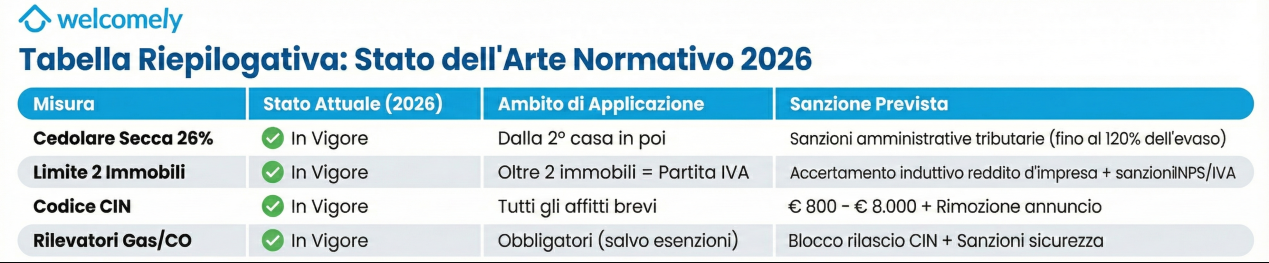
- Up to 2 Properties (Private Regime): You can operate as a private individual, but pay close attention to the rates. The 21% Flat Tax (Cedolare Secca) now applies to only one property of your choice (it is recommended to choose the one with the highest profitability). The second property automatically triggers the increased 26% rate.
- 3 Properties or More (Business Regime): A legal presumption of entrepreneurial activity is triggered. This is no longer optional: if you dedicate more than two properties to short-term rentals, you are obligated to open a VAT number (Partita IVA), register for INPS social security (commercial category), and maintain formal accounting records.
Who does this apply to? All property owners who have 3 or more units intended for short-term rental as defined by Law 50/2017.
2. Hurdles and New Obligations: An Increasingly Complex Framework
In recent years, the short-term rental sector has faced growing regulatory and administrative pressure. The framework has evolved through measures aimed at curbing the phenomenon, most notably:
- Tax Increases: Raising the flat tax to 26% starting from the second unit and the mandatory VAT number from the third property.
- Levy Adjustments: A generalized increase in tourist taxes across numerous tourist destinations.
- Operational Limitations: Restrictions on flow automation (self check-in and key-boxes) and the introduction of strict safety standards (Gas/CO sensors and fire extinguishers).
- New Traceability Obligations: The establishment of the National Database (BDSR) and the mandatory National Identification Code (CIN).
- Local Urban Constraints: Moratoriums on new permits, annual occupancy limits, and increasingly burdensome structural requirements (square footage, parking).
While safety standards and identification codes aim for transparency and legality, the layering of local and fiscal constraints significantly increases management complexity and operating costs. This is pushing the market toward a highly regulated model, where regulatory compliance is a mandatory strategic requirement for business sustainability.
3. The Solution: Trust a Professional Property Manager
Faced with such a complex regulatory landscape—where a single bureaucratic error can cost thousands of euros in fines—the "DIY" management approach has become risky and inefficient.
To protect your assets and maximize your income without the stress, the winning choice is to partner with a structured organization.
Why choose the Welcomely model? Welcomely is not just a manager; we are a strategic partner that transforms your second home into a secure passive income, taking care of everything from legal compliance to guest relations.
Don’t let bureaucracy stop your earnings. Find out more 👉 https://welcomely.it/it/gestione-senza-pensieri/
You're Welcomely ✌🏻